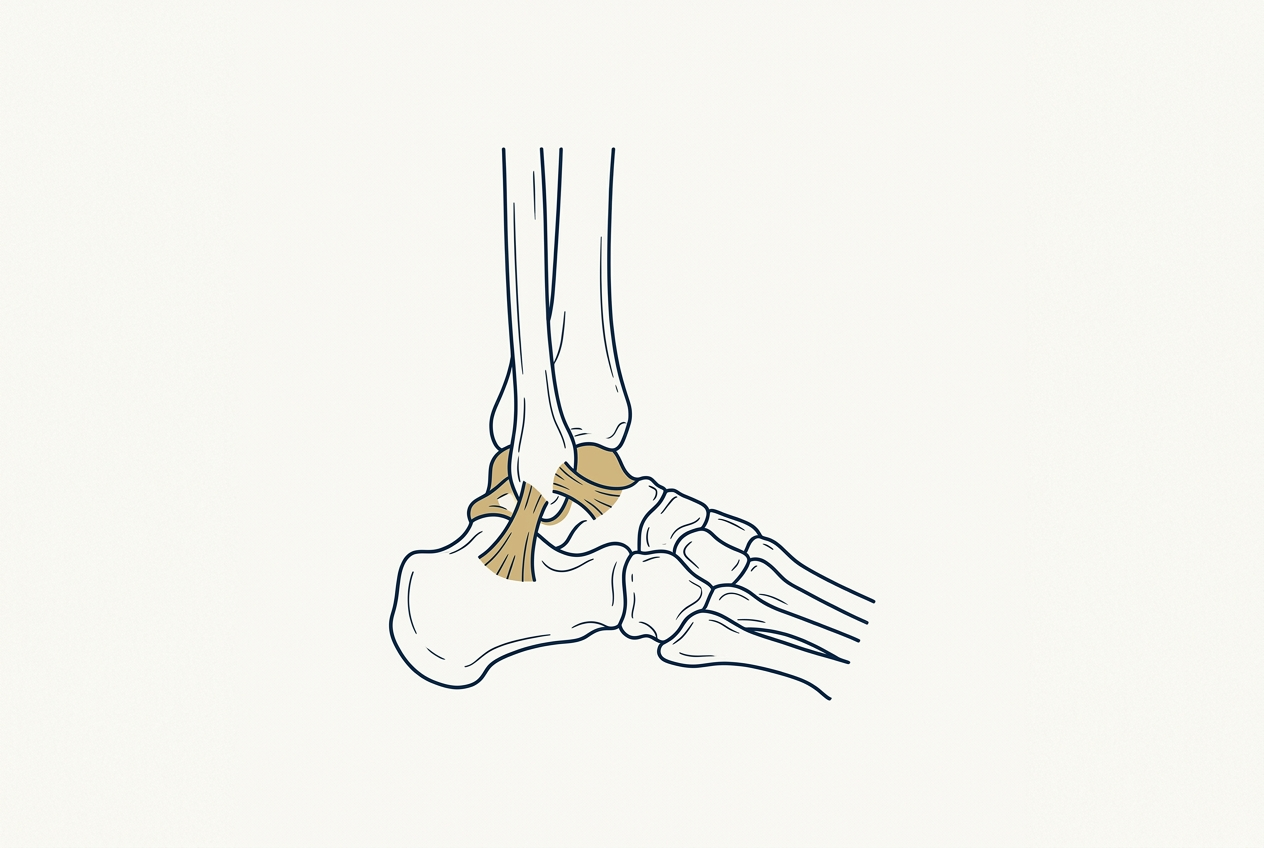
The ankle schedule holds two traps for the unprepared. Unlike the knee, there is no separate code for an ankle that rolls or gives way, so instability has to be translated into motion and pain terms the schedule can pay. And under DC 5271 one limited direction is enough: an ankle that still points down fine but barely flexes up can already sit at 20 percent.
How VA rates ankle conditions
The ankle has its own small block of the musculoskeletal schedule (38 CFR 4.71a): five codes covering everything from a stiff joint to a fused one. Most claims land on DC 5271, limited motion. Since the February 2021 update, "marked" and "moderate" are no longer examiner judgment calls; the schedule defines them in exact degrees.
| Code | Condition | Ratings |
|---|---|---|
| 5270 | Ankylosis (a fused ankle) | 20 to 40 percent, by the position it is fixed in |
| 5271 | Limited motion | 20 percent marked, 10 percent moderate |
| 5272 | Subastragalar or tarsal joint ankylosis | 20 percent in a poor weight-bearing position, 10 in a good one |
| 5273 | Malunion of the os calcis or astragalus | 20 percent marked deformity, 10 moderate |
| 5274 | Astragalectomy (the talus removed) | 20 percent |
The degree cutoffs that decide DC 5271
A healthy ankle moves about 20 degrees upward (dorsiflexion) and about 45 degrees downward (plantar flexion). The schedule now pays on exact measurements:
- 20 percent (marked): less than 5 degrees of dorsiflexion, or less than 10 degrees of plantar flexion
- 10 percent (moderate): less than 15 degrees of dorsiflexion, or less than 30 degrees of plantar flexion
Notice the word or. One bad direction is enough. The goniometer readings in the C&P exam report are the rating, so make sure your treatment records carry real measurements too, not just "decreased range of motion."
The painful motion floor everyone forgets
38 CFR 4.59 holds that a joint with painful motion is entitled to at least the minimum compensable rating, 10 percent, even when the degrees do not reach the moderate cutoffs. An ankle that measures fine but hurts with every step, clicks, or aches on weight bearing should not sit at 0 percent. If the examiner records objective evidence of pain on motion, ask why 4.59 was not applied.
Flare-ups and the after-repetitive-use question
The exam captures one moment. Under 38 CFR 4.40 and 4.45, the rating is supposed to reflect function during flare-ups and after repeated use, when an ankle swells and stiffens. Describe your worst days in concrete terms: how far you can walk, what happens after a work shift, how often it gives out. The examiner is required to estimate the additional loss.
Fusions and replacements
Ankylosis under DC 5270 pays 20 to 40 percent depending on the angle the joint is fixed at, and a surgical fusion is rated the same way. A total ankle replacement (DC 5056) is rated 100 percent for one year after the prosthesis goes in, then 40 percent with chronic severe painful motion or weakness, with a floor of 20 percent.
Instability and sprains: what the schedule does not have
Unlike the knee, the ankle has no separate instability code. Chronic sprains, ligament laxity, and a joint that rolls or gives way are rated through the motion criteria and the painful motion rule, so the record needs to translate instability into those terms: guarded gait, brace use, limited and painful motion. Surgical scars from ligament repairs can rate separately under the skin codes.
Secondary chains
A bad ankle changes the walk, and the changed walk works upward: knee, hip, and low back claims secondary to a service-connected ankle are well-recognized theories under 38 CFR 3.310 with a medical opinion. The chain also runs into the ankle: arthritis that develops in a previously injured joint, and ankle problems driven by service-connected flat feet or plantar fasciitis. When both legs carry compensable ratings, the bilateral factor under 38 CFR 4.26 adds 10 percent of the combined value.
Common rating details veterans overlook
- Get degrees on paper. Treatment notes with goniometer readings beat "reduced ROM" every time.
- One limited direction is enough for DC 5271; dorsiflexion is usually the first to go.
- Painful motion pays 10 percent even with decent measurements (38 CFR 4.59).
- Describe flare-ups in distances and hours, not adjectives.
- Any brace, support, or assistive device you rely on is evidence of functional loss, prescribed or self-selected. So is every giving-way episode in the record.