Toughing it out is the most expensive mistake in a shin splint claim. Every compensable level of DC 5262 requires treatment documented for at least twelve consecutive months, so years of real pain with no treatment record hold a 0 percent file. The rating is built from the paper trail, not the pain.
How VA rates shin splints
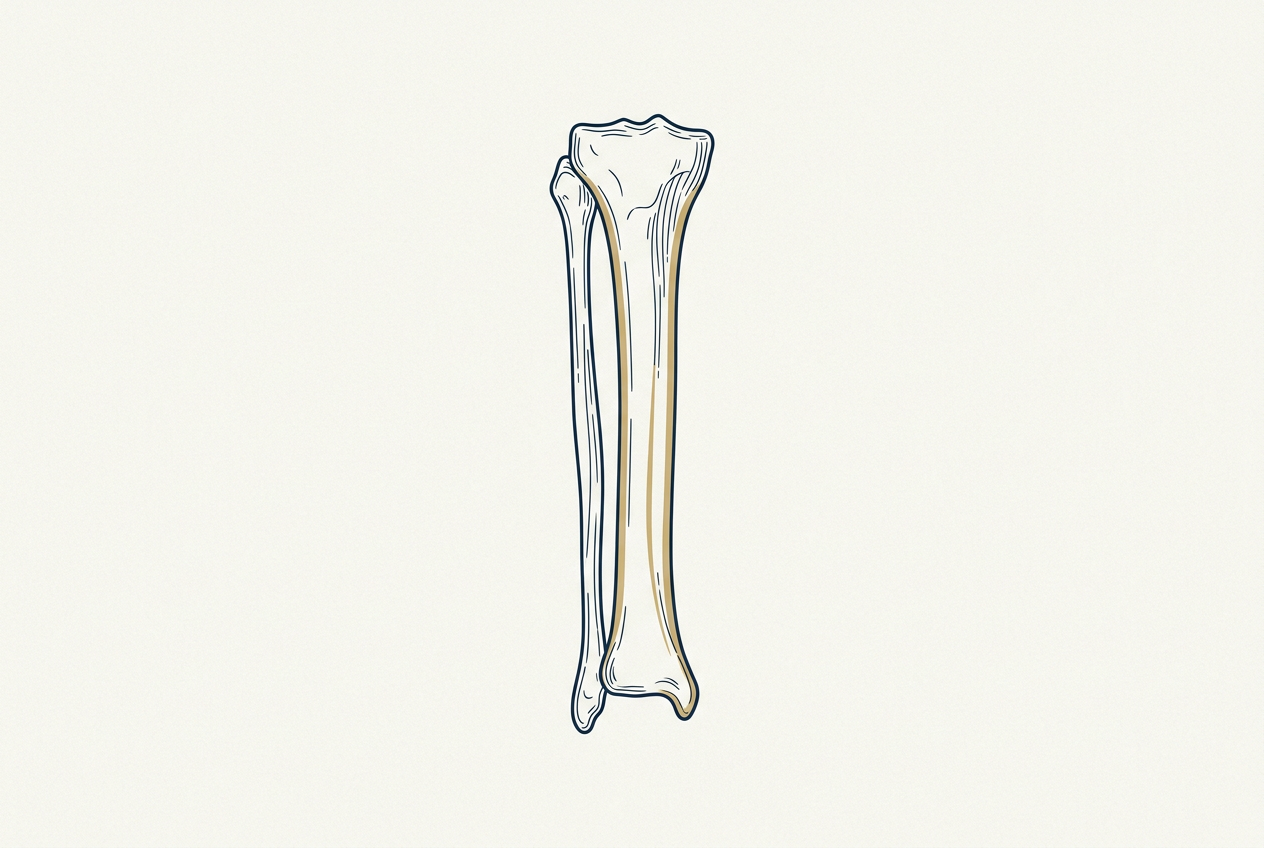
Shin splints, known clinically as medial tibial stress syndrome (MTSS), received their own rating criteria in the February 2021 musculoskeletal update under diagnostic code 5262, impairment of the tibia and fibula (38 CFR 4.71a). Like plantar fasciitis, the rating is built on treatment history, and it runs on a clock: twelve consecutive months.
| Rating | Criteria |
|---|---|
| 30 percent | Treatment for no less than 12 consecutive months, unresponsive to surgery and either shoe orthotics or other conservative treatment, both lower extremities |
| 20 percent | The same, one lower extremity |
| 10 percent | Treatment for no less than 12 consecutive months, unresponsive to shoe orthotics or other conservative treatment, one or both legs |
| 0 percent | Treatment for less than 12 consecutive months |
The twelve month clock
Every compensable level requires treatment for "no less than 12 consecutive months." That is a documentation requirement, not a severity test: physical therapy, orthotics, activity modification, medication, and other conservative care all count, because the regulation's language is open-ended, but whatever treatment you are receiving has to appear in the record continuously. Veterans who tough it out for years without seeing anyone hold a 0 percent file. If your shins have hurt since service, get the treatment relationship on paper and keep it there.
Surgery separates 10 from 20 and 30
Read the criteria closely. The 10 percent level requires only that conservative care failed. The 20 and 30 percent levels require that surgery failed too. Surgery for shin splints is uncommon, and the regulation does not limit the qualifying procedure to any single type; a fasciotomy is one example, but any documented surgical intervention that fails to resolve symptoms satisfies the higher-level criteria. That is why most shin splint ratings top out at 10 percent. If surgery was performed and the pain persists, that single fact doubles or triples the rating; make sure the operative report and the post-surgical complaints are both in the file.
Stress fractures and fracture residuals take a different path
DC 5262 covers more than shin splints. Nonunion of the tibia or fibula with loose motion requiring a brace rates 40 percent. Malunion is rated through the knee or ankle codes, whichever produces the higher evaluation. Untreated MTSS can progress to a tibial stress fracture, and imaging that shows one moves the claim onto these fracture pathways, so keep every X-ray and MRI report.
Both legs, one rating
The 30 percent bilateral level is a single rating that already covers both legs, so the bilateral factor does not apply inside DC 5262 itself. A one-leg 20 percent rating that combines with a compensable rating on the other leg, an ankle or a knee, does trigger the 10 percent bilateral factor addition under 38 CFR 4.26.
Service connection is usually the easy part
Running, rucking, and jumping on hard surfaces make MTSS one of the most common lower-leg diagnoses in service treatment records. The fight is rarely whether shin splints started in service; it is whether the record shows continuous treatment since. Secondary theories run both directions under 38 CFR 3.310: shin pain that changes the gait can aggravate knees, ankles, and hips, and service-connected flat feet or plantar fasciitis can drive MTSS.
Common rating details veterans overlook
- Twelve consecutive months of documented treatment is the gate to any compensable rating.
- Orthotics receipts and physical therapy notes are the evidence; keep the paper trail unbroken.
- An operative report changes the ceiling from 10 to 20 or 30 percent.
- Describe standing and walking limits at the exam; functional loss under 38 CFR 4.40 frames severity.
- Imaging that shows a stress fracture opens the separate fracture criteria, including the 40 percent nonunion level.