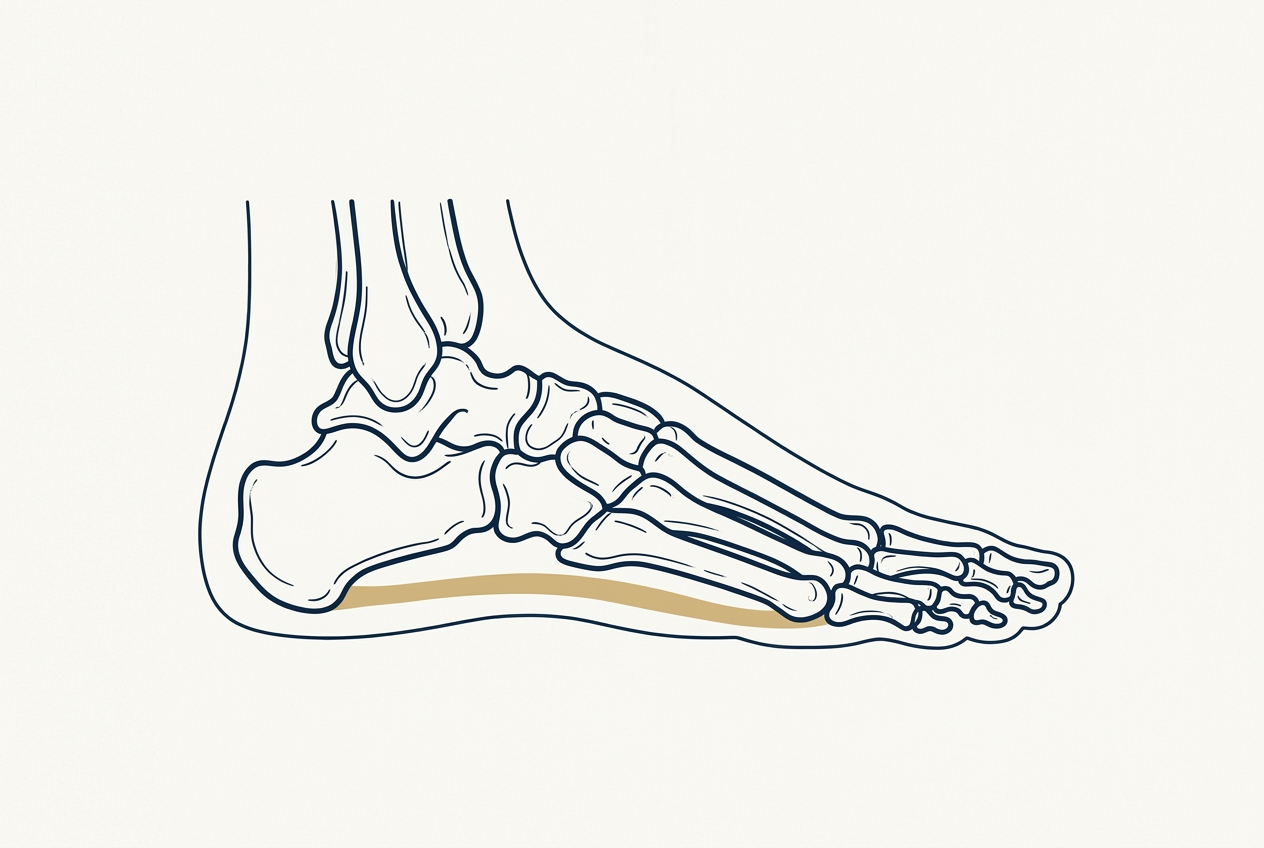
The plantar fasciitis rating barely asks how much your heel hurts today. DC 5269 pays on treatment history: the higher levels require that both non-surgical and surgical care failed, which makes your podiatry paper trail the actual claim. And the most overlooked sentence in the foot schedule lets a veteran who cannot safely have the recommended surgery rate as if it had been tried and failed.
How VA rates plantar fasciitis
Plantar fasciitis is rated under diagnostic code 5269 in the musculoskeletal schedule (38 CFR 4.71a). It received its own diagnostic code in the February 2021 rewrite of the foot criteria; before that, VA rated it by analogy to flatfoot or other foot injuries. The criteria are unusual for the rating schedule: the percentage turns almost entirely on your treatment history, not on how much your heel hurts on the day of the exam.
| Rating | Criteria |
|---|---|
| 30 percent | No relief from both non-surgical and surgical treatment, bilateral |
| 20 percent | No relief from both non-surgical and surgical treatment, unilateral |
| 10 percent | Otherwise, unilateral or bilateral |
Two notes sit under that table, and each is worth more than the table itself. Note (1): with actual loss of use of the foot, the schedule directs a 40 percent rating. Note (2): if surgery has been recommended but you are not a surgical candidate, VA evaluates you under the 20 or 30 percent criteria anyway, whichever applies.
The treatment gate, in plain English
"No relief from both non-surgical and surgical treatment" is a documentation test. Non-surgical treatment means the standard podiatry menu: custom orthotics or arch supports, stretching programs and physical therapy, night splints, anti-inflammatory medication, and corticosteroid injections. Surgical treatment includes procedures such as plantar fascia release, gastrocnemius recession, and endoscopic techniques; the regulation does not limit qualifying surgery to any single procedure, so document whatever operation was performed or recommended. To move past 10 percent, the record has to show you went through both routes and the pain stayed. The sentence that wins the higher rating lives in your treatment notes, not in your lay statement: ask your provider to record, in plain words, that symptoms persist despite each non-surgical treatment attempted, listing them out specifically, since the regulation covers any non-surgical care and does not require a fixed combination, and that symptoms also persist after surgery.
The not-a-surgical-candidate secret
Note (2) is the most overlooked sentence in the foot schedule. Many veterans are told surgery is an option but never have it: the modest success rate scares them off, or diabetes, vascular disease, obesity, or anesthesia risk takes the operation off the table. If a surgeon recommended the procedure and the record shows you cannot or should not have it, the schedule treats you as if surgery had been tried and failed, and the 20 and 30 percent levels open up without a scalpel. Get both halves in writing: the recommendation, and the reason you are not a candidate.
Loss of use and the 40 percent path
"Actual loss of use" means the foot works no better for you than an amputation with a prosthesis would, judged on balance and propulsion under 38 CFR 3.350. It is a high bar, but veterans with severe bilateral disease, failed surgeries, and a scooter or wheelchair for anything beyond short distances should know it exists, because loss of use of a foot also carries special monthly compensation at the SMC(k) rate, paid on top of the regular monthly check.
Secondary claims from a changed gait
Plantar fasciitis changes how you walk, and an antalgic gait changes how every joint above the foot carries load. Knee, hip, and low back conditions, and problems in the opposite foot from years of favoring one side, are all recognized secondary theories under 38 CFR 3.310 when a medical opinion connects them. The chain runs the other way too: plantar fasciitis that developed because of service-connected flat feet, an ankle injury, or a leg length difference is itself a secondary claim.
Flatfoot, pyramiding, and the bilateral factor
Plantar fasciitis and flatfoot (pes planus, DC 5276) are different diagnoses that often live in the same foot. VA cannot pay twice for the same manifestation (38 CFR 4.14), but where the record separates fascia pain from the structural collapse findings that drive the flatfoot criteria, separate ratings are possible. One more wrinkle: the 30 percent level already prices in both feet, so no bilateral factor applies inside DC 5269 itself. But a single-foot plantar fasciitis rating that combines with another rating on the other leg, a knee or an ankle, triggers the 10 percent bilateral factor addition under 38 CFR 4.26.
Common rating details veterans overlook
- Document each foot separately. The 20 and 30 percent levels turn on unilateral versus bilateral, so the record needs findings for both feet.
- Keep every failed treatment on paper. Orthotics receipts, physical therapy discharge summaries, injection notes: the rating is built from that trail.
- Describe standing and walking limits at the exam. Functional loss under 38 CFR 4.40 and 4.45 frames how the examiner reports severity.
- A recommendation against surgery is evidence, not a dead end. Note (2) exists for exactly that file.
- If your feet end standing work and your combined rating qualifies, individual unemployability under 38 CFR 4.16 pays at the 100 percent rate.