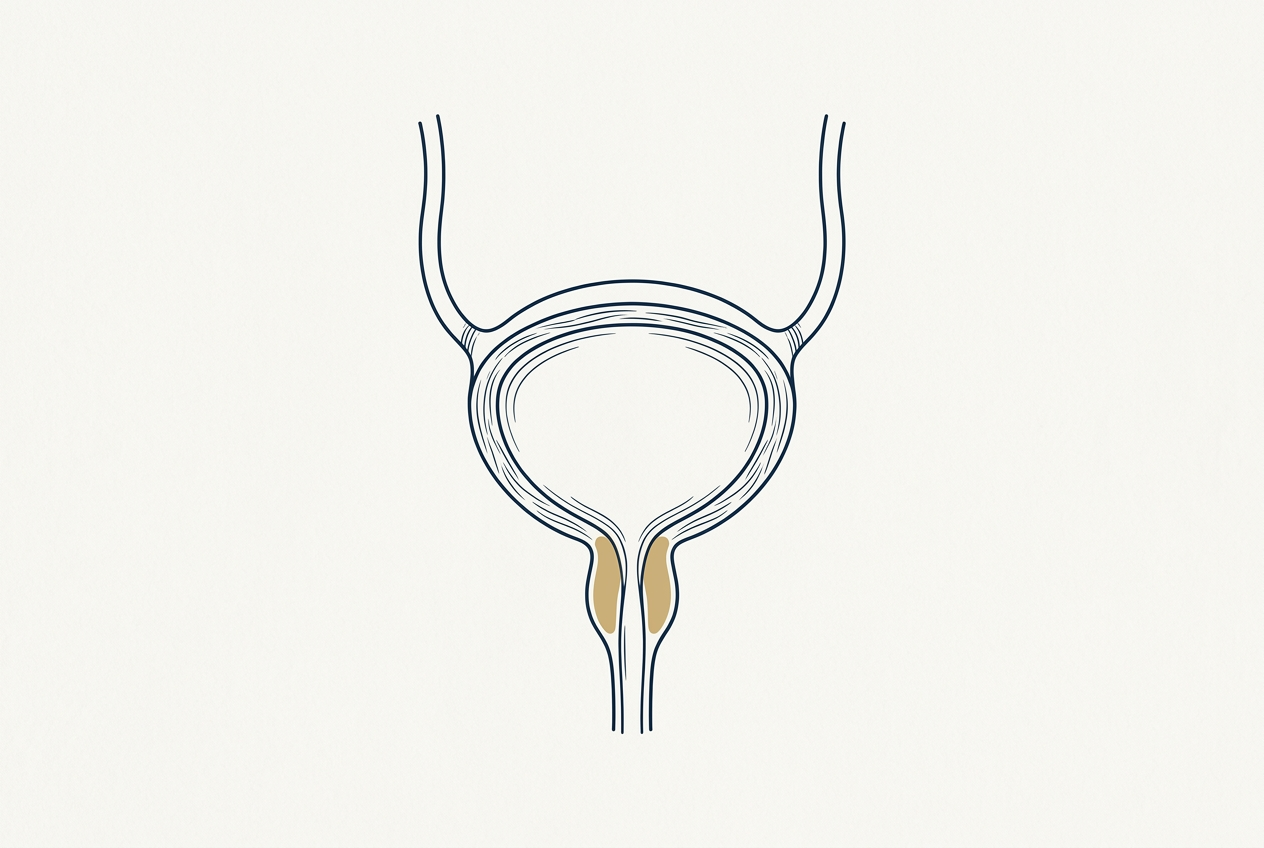
Veterans embarrassed to talk about leakage routinely leave the highest paying lane of 38 CFR 4.115a undocumented. The machinery is blunt: the pad count is the rating, an appliance or more than four changes a day reaches 60 percent, and VA rates whichever lane, leakage, frequency, or obstruction, predominates. Say the number at every appointment, because a note that says wears pads and a note that says changes pads three times daily pay very differently.
How VA rates voiding dysfunction
Voiding dysfunction is not a diagnosis. It is the rating machinery behind most urinary conditions in the schedule (38 CFR 4.115a). Prostate cancer residuals, an enlarged prostate, chronic cystitis, neurogenic bladder, urethral strictures, incontinence after surgery: their diagnostic codes all point here. The section offers three lanes, leakage, frequency, and obstruction, and VA rates the predominant one. Knowing what each lane pays, and what evidence each lane runs on, is how these claims are won.
Lane one: urine leakage (20 to 60 percent)
| Rating | Criteria |
|---|---|
| 60 percent | Requires an appliance, or absorbent materials that must be changed more than 4 times per day |
| 40 percent | Absorbent materials that must be changed 2 to 4 times per day |
| 20 percent | Absorbent materials changed less than 2 times per day |
For the 40 and 20 percent levels, the pad count is the rating. A treatment note that says "wears pads" supports 20 percent; a note that says "changes absorbent pads three times daily" supports 40. That one number, written down by a clinician, is often worth hundreds of dollars a month. Say the number at every appointment. The 60 percent level has two independent paths: requiring an appliance such as an external catheter, condom catheter, or urinary collection device, or absorbent materials changed more than four times daily. A veteran who relies on any qualifying appliance reaches 60 percent regardless of pad frequency, so the type of management used should be documented clearly in the record.
Lane two: urinary frequency (10 to 40 percent)
| Rating | Criteria |
|---|---|
| 40 percent | Daytime voiding interval under one hour, or waking to void five or more times per night |
| 20 percent | Interval between one and two hours, or waking three to four times per night |
| 10 percent | Interval between two and three hours, or waking twice per night |
Nocturia is the evidence most veterans never write down. A simple two week bladder diary, times and counts, handed to the examiner, is the strongest document this lane ever sees.
Lane three: obstructed voiding (0 to 30 percent)
Urinary retention requiring intermittent or continuous catheterization rates 30 percent. Below that, 10 percent requires marked obstructive symptoms (hesitancy, slow or weak stream) plus one objective finding: post-void residual over 150 cc, peak flow under 10 cc per second, recurrent obstruction-driven infections, or stricture disease needing dilatation every 2 to 3 months. Any qualifying catheter use, whether self-administered intermittent catheterization, an indwelling urethral catheter, or catheterization managed by a caregiver, puts the 30 percent line in play.
The predominant rule and its quiet exception
Only the predominant area of dysfunction is rated; leakage, frequency, and obstruction do not stack for the same condition. But the September 2021 update added a sentence worth knowing: distinct disabilities may be evaluated separately under this section, per 38 CFR 4.14, when their symptoms do not overlap. Two different service-connected conditions producing two different dysfunctions can each carry a rating. And within one condition, make sure VA picked the lane that actually pays more: a veteran rated 20 percent for frequency whose record supports 40 percent for leakage is leaving money on the table.
Urinary tract infections
Recurrent symptomatic infections have their own small ladder: 30 percent for infections requiring stent or nephrostomy drainage, more than two hospitalizations a year, or continuous intensive management; 10 percent for one to two hospitalizations a year or suppressive drug therapy lasting six months or more. Poor renal function moves the whole claim to the renal dysfunction criteria instead.
Where this machinery shows up
The clearest example is prostate cancer. DC 7528 rates active cancer at 100 percent, then directs that residuals be rated as voiding dysfunction or renal dysfunction, whichever predominates. After a prostatectomy, the leakage lane usually pays best, and erectile dysfunction from the same surgery carries special monthly compensation under SMC(k) on top. The same lanes rate incontinence in women veterans, post-surgical leakage, overactive bladder, and neurogenic bladder from spine or nerve conditions.
Common rating details veterans overlook
- State pad changes per day as a number, at every appointment.
- Keep a bladder diary for two weeks before the C&P exam.
- Any catheter use belongs in the record; it anchors the 30 percent obstruction line.
- Check which lane VA used. The predominant lane should be the one that pays the most your evidence supports.
- Nerve and spine conditions cause bladder dysfunction; a neurogenic bladder secondary to a service-connected back is a recognized claim under 38 CFR 3.310.