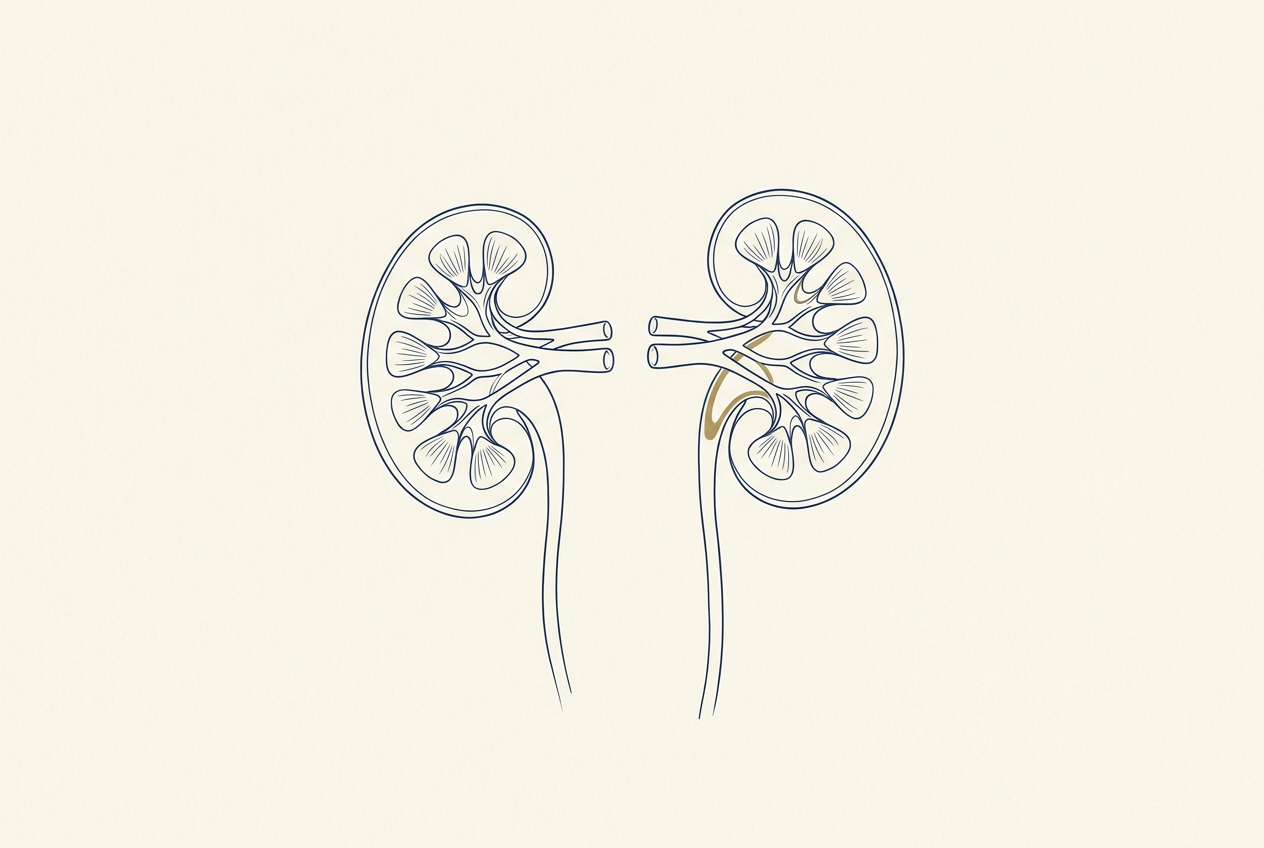
A kidney disease rating is not built at the exam. It is built in your lab history, because the criteria run on GFR bands sustained for three consecutive months, and no single appointment can prove that. The other quiet fact: an early 0 percent grant is one of the most valuable in the schedule, since kidney function tends to fall and the service connection is already locked when it does.
How VA rates kidney disease
Chronic kidney disease is rated on the renal dysfunction scale in 38 CFR 4.115a, and the individual kidney diagnostic codes in 38 CFR 4.115b (chronic renal disease, nephritis, cystic kidney disease, and others) all point back to it. The modern criteria are almost purely laboratory driven: the rating follows your glomerular filtration rate (GFR), the standard measure of kidney function, sustained for at least 3 consecutive months during the past 12 months.
The percentage levels
- 0 percent: GFR of 60 to 89 mL/min/1.73 m2 combined with recurrent cell casts in the urine, structural kidney abnormalities, or an albumin/creatinine ratio of 30 mg/g or higher.
- 30 percent: chronic kidney disease with GFR from 45 to 59.
- 60 percent: chronic kidney disease with GFR from 30 to 44.
- 80 percent: chronic kidney disease with GFR from 15 to 29.
- 100 percent: GFR below 15, or a requirement for regular routine dialysis, or status as an eligible kidney transplant recipient.
Each band must hold for at least 3 consecutive months during the past 12, and a note confirms that estimated GFR (eGFR), the number printed on routine bloodwork, is accepted when calculated by a medical professional.
Dialysis and transplants
Chronic renal disease requiring regular dialysis (DC 7530) rates as renal dysfunction, which lands at 100 percent by definition. A kidney transplant (DC 7531) is rated 100 percent from the date of hospital admission for the surgery, with a mandatory VA examination one year after discharge; afterward the residuals are rated as renal dysfunction with a 30 percent minimum, and any reduction must follow the procedural protections of 38 CFR 3.105(e), including advance notice.
Your lab history is the claim
Because the criteria are GFR bands over time, the single most valuable thing you can do is get your complete laboratory history into the claims file: every metabolic panel showing eGFR and creatinine, urinalysis results showing casts or protein, and any imaging showing structural abnormality. A one-time exam cannot establish "3 consecutive months"; the trend line in your records does.
The 0 percent rating is worth having
Early-stage kidney disease with GFR still above 60 rates 0 percent, which pays nothing but establishes service connection. Kidney function tends to decline, and a veteran already service connected at 0 percent files a simple increase claim when the GFR crosses a band, with an effective date tied to that claim rather than starting from scratch.
Kidney disease rarely starts in the kidneys
The two most common causes of chronic kidney disease are diabetes and hypertension, both frequently service connected. Diabetic nephropathy secondary to service-connected diabetes, or kidney damage secondary to long-standing hypertension, is a classic 38 CFR 3.310 secondary claim. The relationship also runs backward: kidney disease commonly causes or worsens hypertension and anemia, which may warrant their own evaluations.
Common rating details veterans overlook
- eGFR on routine bloodwork counts. The criteria accept estimated GFR calculated by a medical professional.
- The 3 consecutive month requirement means lab history, not a single reading, sets the band.
- Transplant recipients carry a 30 percent floor for life and procedural protection against casual reductions.
- Anemia, bone disease, and hypertension caused by kidney disease may be separately compensable; ask whether each residual is rated.