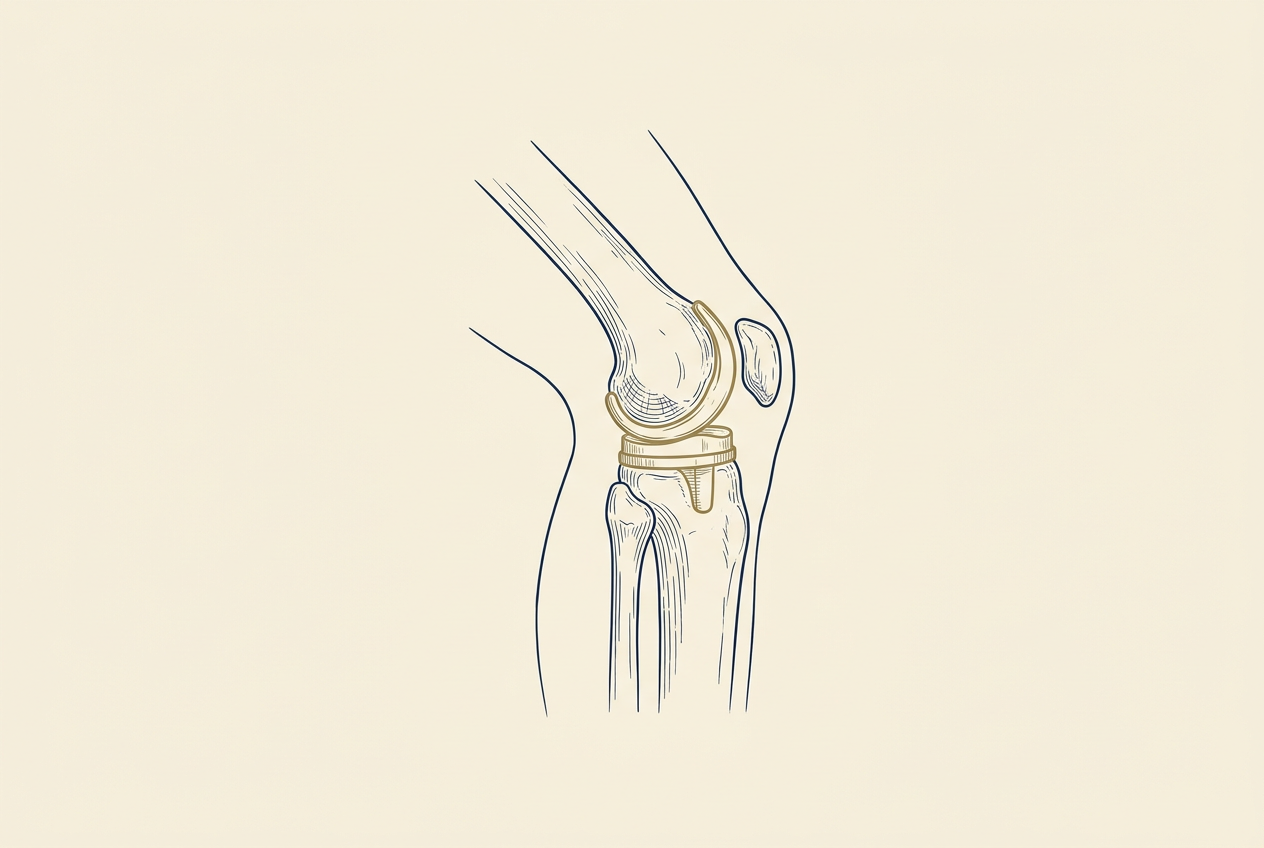
Two veterans get the same total knee replacement, yet one is paid at the 100 percent rate for about five months and the other for only four. The difference is a single note in the rating schedule that starts the clock after the convalescence month, not on surgery day. Details like that decide most of the money in a DC 5055 rating.
How VA rates a knee replacement
Knee resurfacing or replacement is rated under diagnostic code 5055 in 38 CFR 4.71a. The rule was rewritten effective February 7, 2021, and the current version works on a timeline: a long stretch at 100 percent right after surgery, then a permanent rating based on what the knee can actually do once it heals.
| Stage | Rating |
|---|---|
| For 4 months following implantation of prosthesis or resurfacing | 100 percent |
| Chronic residuals consisting of severe painful motion or weakness in the affected extremity | 60 percent |
| Intermediate degrees of residual weakness, pain, or limitation of motion | Rated by analogy to DC 5256, 5261, or 5262 |
| Minimum evaluation, total replacement only | 30 percent |
The 100 percent window is really about five months
Note (5) to the prosthetic implant codes is the sentence almost nobody reads: the 4 months at 100 percent do not start on surgery day. They start after the initial one month total rating assigned under 38 CFR 4.30 following hospital discharge. Stacked together, a knee replacement pays at the 100 percent rate for about five months. If an award letter starts the 4 month clock on the date of surgery, the convalescence month was skipped, and that is worth challenging.
The 30 percent floor applies to total replacements only
Before 2021, DC 5055 carried a lifetime 30 percent minimum for any prosthetic knee work. The current rule is narrower. Note (3) defines prosthetic replacement as a total replacement of the joint. A partial (unicompartmental) knee replacement and a resurfacing procedure still get the 4 month window at 100 percent, but after that there is no minimum: VA rates the actual residuals under the ordinary knee codes for limitation of motion, instability, or ankylosis. If the residuals are mild, that rating can lawfully land at 10 percent or even 0. Veterans with a total replacement keep the 30 percent floor for as long as the knee is rated under DC 5055.
What the 60 percent level takes
The 60 percent level requires chronic residuals of severe painful motion or weakness in the affected extremity. The evidence that carries it is specific: documented flare-ups, the distance you can walk, giving way, use of a cane or brace, and what the pain does to standing, stairs, and sleep. A knee that is better than before surgery but still limits daily life usually lands in the intermediate zone, rated by analogy to ankylosis (DC 5256), limitation of extension (DC 5261), or tibia and fibula impairment (DC 5262), with the 30 percent minimum as the floor for total replacements.
Revisions do not always restart the clock
Note (2) is another quiet one: a revision surgery is only rated like the original replacement, with the full 100 percent window, when all of the original components are replaced. A revision that replaces fewer than all of the original components is handled with a temporary convalescence rating under 38 CFR 4.30, regardless of how many individual components are swapped. Only a revision in which every original component is replaced triggers the full 100 percent window.
Common rating details veterans overlook
- The 4 month clock starts after the 4.30 month. Check the effective dates on the award letter (Note 5).
- Special monthly compensation during the 100 percent window. Note (6) makes SMC assignable from the earliest date permanent use of crutches is established.
- A 60 percent knee alone meets the TDIU threshold. 38 CFR 4.16(a) requires one disability rated 60 percent; if the knee keeps you from holding substantially gainful work, TDIU pays at the 100 percent rate.
- Both knees replaced brings the bilateral factor. Under 38 CFR 4.26, VA combines the two knee ratings and adds 10 percent of that combined value before finishing the math.
- A reduction after the 100 percent window is not automatic. VA schedules an examination, and lowering a running compensation payment must follow the notice and response procedures of 38 CFR 3.105(e).