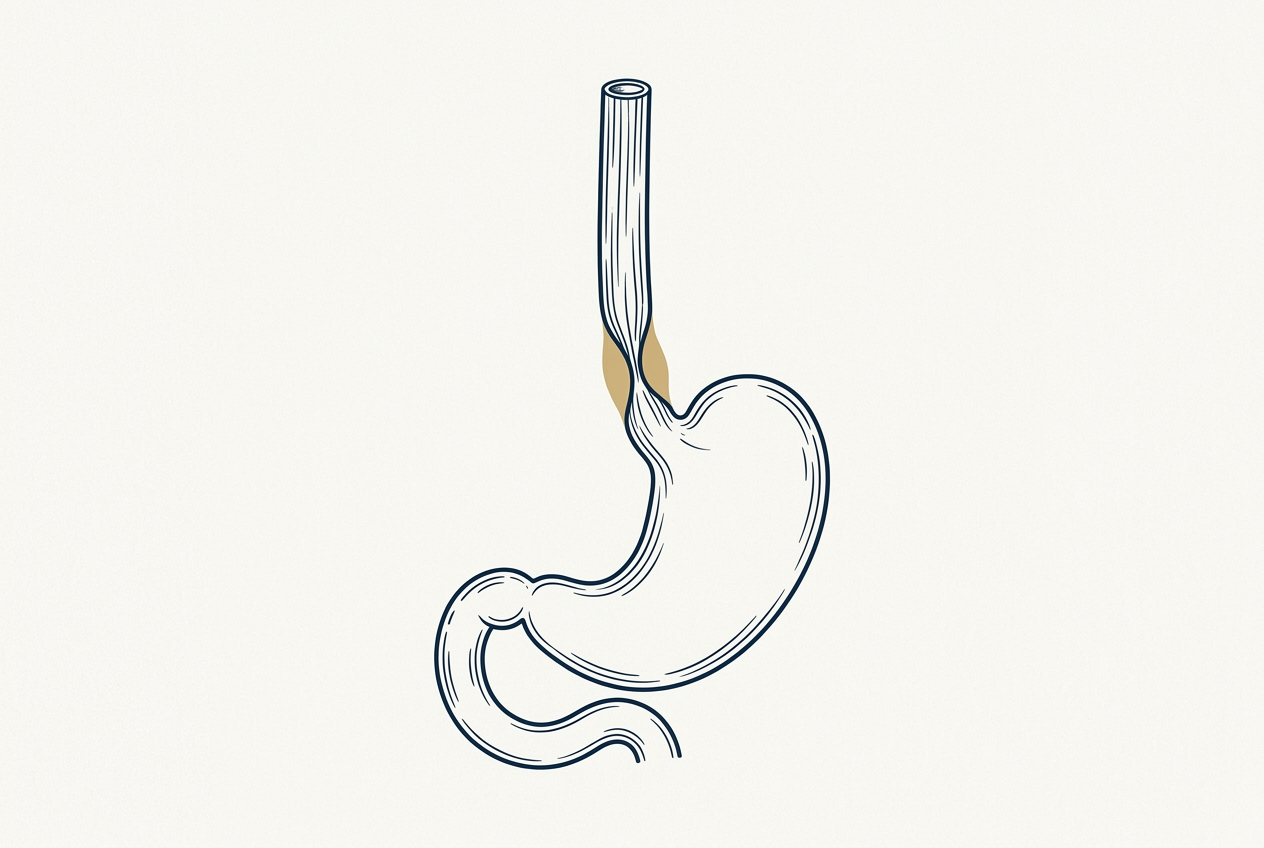
Fifteen years of daily omeprazole can be worth exactly 0 percent under the current GERD code. Since May 2024 the rating turns on documented esophageal strictures and trouble swallowing, not on how bad the heartburn feels. The most important document in a GERD file is now a scope or imaging report, and a file without one has no compensable rating to stand on.
How VA rates GERD
Gastroesophageal reflux disease is rated under diagnostic code 7206 in the digestive schedule (38 CFR 4.114). The code is new: before May 19, 2024, GERD had no diagnostic code of its own and was rated by analogy to hiatal hernia. The 2024 rewrite rebuilt the criteria around one objective question: has reflux damaged the esophagus enough to cause strictures (narrowing) and documented trouble swallowing (dysphagia)?
| Rating | Criteria |
|---|---|
| 80 percent | Documented history of recurrent or refractory stricture(s) causing dysphagia, with at least one of aspiration, undernutrition, or substantial weight loss as defined in 38 CFR 4.112(a), treated with surgical correction or a feeding tube (such as a PEG tube, nasogastric tube, or jejunostomy tube) |
| 50 percent | Documented history of recurrent or refractory stricture(s) causing dysphagia requiring dilatation 3 or more times per year, dilatation using steroids at least once per year, or an esophageal stent |
| 30 percent | Documented history of recurrent stricture(s) causing dysphagia requiring dilatation no more than 2 times per year |
| 10 percent | Documented history of stricture(s) that requires daily medication to control dysphagia, otherwise asymptomatic |
| 0 percent | Documented history without daily symptoms or a requirement for daily medication |
The scope-and-imaging gate
The note under the criteria is the whole ballgame: findings must be documented by an objective study, including a barium swallow, computerized tomography, or esophagogastroduodenoscopy (an EGD, the camera scope), which are the modalities named in the note, though the regulation does not limit acceptable documentation to only those three. Heartburn described at a C&P exam moves nothing. A veteran who has managed reflux with omeprazole for fifteen years but has never had a scope holds a 0 percent file under the current rule. If swallowing has ever caught, stuck, or hurt, ask for the EGD referral, because the rating is built from those reports.
Recurrent and refractory are defined words
The schedule defines both terms, and the definitions decide the jump from 30 to 50. A stricture is recurrent when the esophagus cannot hold its target diameter for more than 4 weeks after dilatation reaches it. It is refractory when the target diameter cannot be reached at all despite at least 5 dilatation sessions at 2 week intervals. Keep a simple dated list of every dilatation: the difference between "no more than 2 per year" and "3 or more per year" is the difference between 30 and 50 percent.
Rated before May 19, 2024? The old rating is protected
Federal law says a rating schedule change cannot, by itself, reduce a rating already in effect; VA must show the condition actually improved (38 U.S.C. 1155). Veterans rated for GERD under the old hiatal hernia analogy keep that evaluation. The tradeoff: a claim for an increase filed today is decided under the current stricture-based criteria, so make sure the objective evidence exists before filing.
Esophagitis, Barrett's, and the wide Note (3)
The stricture criteria do a lot of work beyond GERD. The parallel code for stricture of the esophagus (DC 7203) sweeps in mechanical and chemical esophagitis, Mallory Weiss tears, drug-induced and infectious esophagitis, eosinophilic esophagitis, radiation esophagitis, peptic stricture, and any esophageal condition treated with sclerotherapy. Barrett's esophagus has its own code (DC 7207): with a stricture it rates under the same criteria; without one, pathology controls, 30 percent for high-grade dysplasia and 10 percent for low-grade. If malignancy ever develops, the claim moves to the digestive cancer code and the 100 percent cancer rules take over.
The secondary pathways
GERD is one of the most commonly claimed secondary conditions, and 38 CFR 3.310 is the vehicle. The well-traveled chains: reflux caused or aggravated by NSAIDs taken for service-connected joint and back conditions, and reflux tied to PTSD and the medications that treat it. That theory has its own walkthrough on this site, linked below, including what the nexus opinion needs to say.
Common rating details veterans overlook
- Ask for the scope. Without an EGD, barium swallow, or CT in the record, there is no compensable rating under this code, whatever the symptoms.
- Count dilatations by calendar year and keep every procedure report.
- Weight loss must be "substantial" as the schedule defines it (38 CFR 4.112), measured against your baseline weight; casual estimates do not count.
- The 80 percent level needs treatment plus a complication, not just severe symptoms: surgery or a PEG tube along with aspiration, undernutrition, or substantial weight loss.
- Complications outside the gut rate separately. The schedule sends non-digestive complications of procedures to their own body systems, and aspiration events that damage the lungs belong in the respiratory schedule.
Related on this site
- GERD secondary to PTSD and medication
- The 2024 digestive rating changes
- How VA rates ulcers (DC 7304)
- How VA rates IBS (DC 7319)
- How VA rates hernias (DC 7338)
- How VA rates cancer: the 100 percent rule and residuals
Common questions
Why did my GERD claim get 0 percent despite daily heartburn?
Because the current criteria rate objective esophageal damage, not symptoms. Since May 19, 2024, GERD under diagnostic code 7206 turns on documented strictures (narrowing) causing trouble swallowing, proven by an objective study such as an EGD scope, barium swallow, or CT. Heartburn described at a C&P exam moves nothing, and a veteran who has managed reflux with medication for years but never had a scope holds a 0 percent file under the current rule.
What evidence do I need for a compensable GERD rating?
An objective study documenting strictures: the note under the criteria names a barium swallow, computerized tomography, or esophagogastroduodenoscopy (the EGD camera scope). If swallowing has ever caught, stuck, or hurt, ask for the EGD referral, because the rating is built from those reports. Then keep a dated list of every dilatation: dilatation no more than 2 times per year rates 30 percent, while 3 or more per year, steroid dilatation, or an esophageal stent rates 50 percent.
I was rated for GERD before the 2024 change. Do I keep my rating?
Yes. Federal law says a rating schedule change cannot, by itself, reduce a rating already in effect; VA must show the condition actually improved (38 U.S.C. 1155). Veterans rated under the old hiatal hernia analogy keep that evaluation. The tradeoff is that a claim for an increase filed today is decided under the current stricture based criteria, so make sure the objective evidence exists before filing.
Can GERD be secondary to PTSD or medications?
Yes, and it is one of the most commonly claimed secondary conditions under 38 CFR 3.310. The well traveled chains are reflux caused or aggravated by NSAIDs taken for service connected joint and back conditions, and reflux tied to PTSD and the medications that treat it. The nexus opinion connecting them is the core of the claim.
What does the 80 percent GERD level require?
Treatment plus a complication, not just severe symptoms: a documented history of recurrent or refractory strictures causing dysphagia, with at least one of aspiration, undernutrition, or substantial weight loss as defined in 38 CFR 4.112(a), treated with surgical correction or a feeding tube. Weight loss must be substantial as the schedule defines it, measured against your baseline weight.