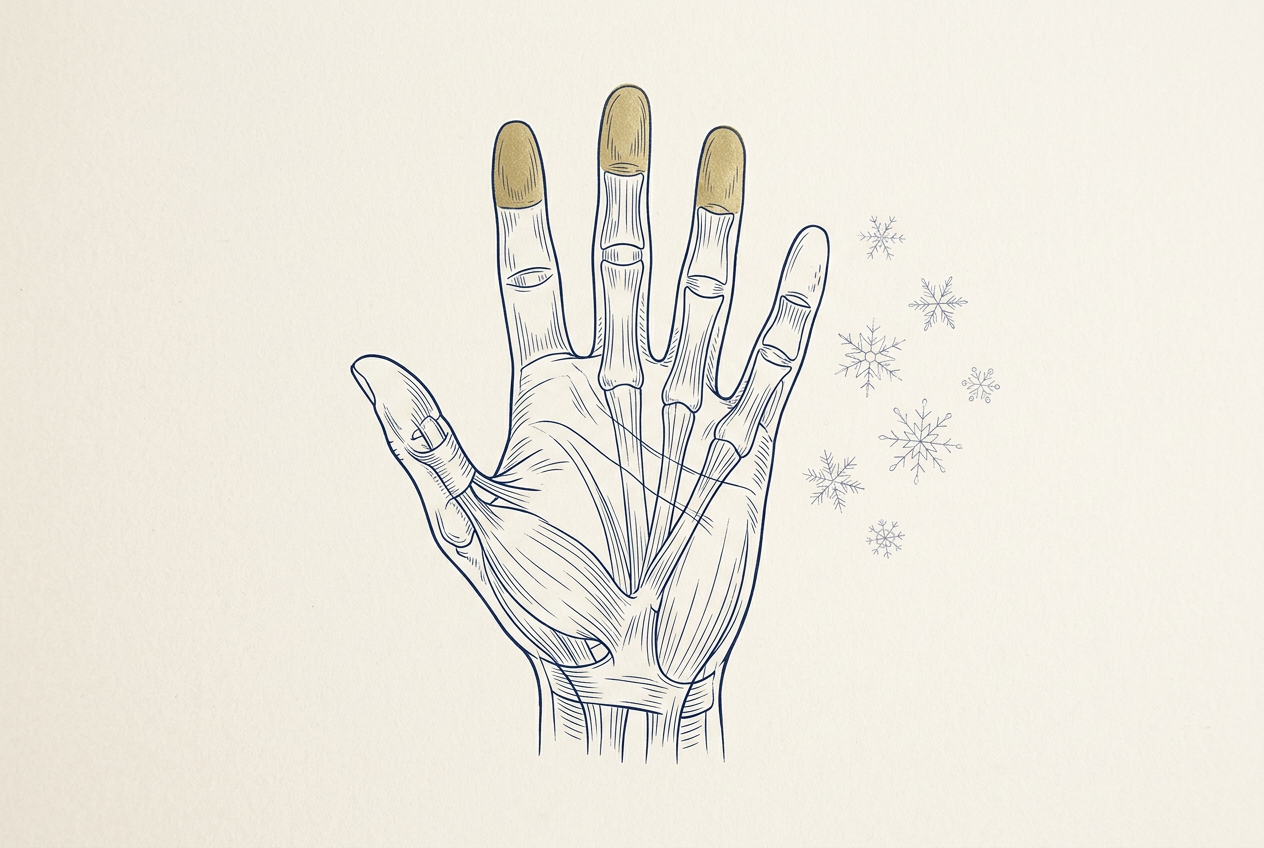
Veterans with Raynaud's often assume a condition no examiner will ever witness cannot be documented. The schedule anticipates that: the rating runs on attack frequency, and the dated diary of attacks, triggers, and color changes is the evidence the criteria are built to accept. The quieter trap is the diagnosis wording, since Raynaud's syndrome under DC 7117 climbs to 100 percent while primary Raynaud's disease under DC 7124 tops out at 10.
Veterans with Raynaud's often assume that a condition no examiner will ever witness cannot be documented. The rating schedule anticipates that: the criteria run on attack frequency, and a dated diary of attacks, triggers, and color changes is exactly the evidence they are built to accept. The quieter trap is the diagnosis wording. Raynaud's syndrome under DC 7117 climbs to 100 percent, while primary Raynaud's disease under DC 7124 tops out at 10.
How VA rates Raynaud's
Raynaud's syndrome is rated under diagnostic code 7117 in 38 CFR 4.104. The entire schedule turns on one variable: how often the characteristic attacks happen.
| Rating | Criteria |
|---|---|
| 100 percent | Two or more digital ulcers plus auto-amputation of one or more digits, with a history of characteristic attacks |
| 60 percent | Two or more digital ulcers with a history of characteristic attacks |
| 40 percent | Characteristic attacks occurring at least daily |
| 20 percent | Characteristic attacks occurring four to six times a week |
| 10 percent | Characteristic attacks occurring one to three times a week |
Note (1) defines a characteristic attack: sequential color changes of the digits of one or more extremities, lasting minutes to hours, sometimes with pain and tingling, brought on by cold exposure or emotional stress. The rating covers the disease as a whole, regardless of how many hands, feet, ears, or the nose are involved.
The diary is the rating
Attacks happen in a cold parking lot in January, not in a heated exam room in June. No examiner will ever witness one, which means the frequency evidence is yours to build. Keep a dated log of attacks: when it happened, what triggered it, which fingers were affected, how long it lasted, and the color sequence. Add photos taken mid-attack and a statement from a spouse or coworker who regularly sees the white-then-blue fingers. The difference between "attacks a few times a week" and a documented daily pattern is the difference between 20 and 40 percent.
The primary versus secondary fork
This is the quiet trap in the diagnosis wording. DC 7117 covers Raynaud's syndrome, also called secondary Raynaud's, the form associated with an underlying condition, and it runs to 100 percent. Raynaud's disease, the primary form with no underlying cause, is rated under DC 7124, which tops out at 10 percent (attacks with trophic changes such as tight shiny skin or nail deformities) or 0 percent without them. Which code applies follows the diagnosis in your record. If a rheumatologist ties your Raynaud's to an underlying condition, the claim moves from a 10 percent ceiling to a 100 percent ladder.
Where the service connection comes from
- Cold injury. Veterans with documented cold exposure, from Korea-era service to cold weather training, often carry cold injury residuals (DC 7122). Raynaud's phenomenon is a recognized late effect of frostbite and non-freezing cold injury. The cold injury and the Raynaud's are rated as the evidence supports, without paying twice for the same manifestation.
- Secondary to medication. Beta blockers, a first-line treatment for service-connected hypertension and heart conditions, are a well-documented aggravator of Raynaud's. That is a 38 CFR 3.310 secondary theory most veterans never raise.
- Vibration exposure. Years on impact tools, rotary wing airframes, or flight lines produce hand-arm vibration injury with Raynaud's-type vasospasm.
- Autoimmune disease. Lupus, scleroderma, and related connective tissue diseases carry secondary Raynaud's. If the autoimmune condition is service connected, the Raynaud's follows it.
Common rating details veterans overlook
- Digital ulcers move the rating to 60 percent. Any fingertip sore, fissure, or slow-healing crack during cold months belongs in a treatment note with the word "ulcer" where accurate.
- The whole-body rule cuts both ways. Attacks in the feet, ears, or nose count toward the overall picture, but more extremities does not mean more ratings under 7117.
- Cold avoidance is occupational evidence. If the condition forces you out of outdoor trades, refrigerated warehouses, or winter duty, that is TDIU-relevant impairment. Document the work impact.
- Fibromyalgia overlap. Raynaud's-like symptoms appear in the fibromyalgia criteria (DC 5025). The same symptom is rated once, under whichever code the evidence supports best.