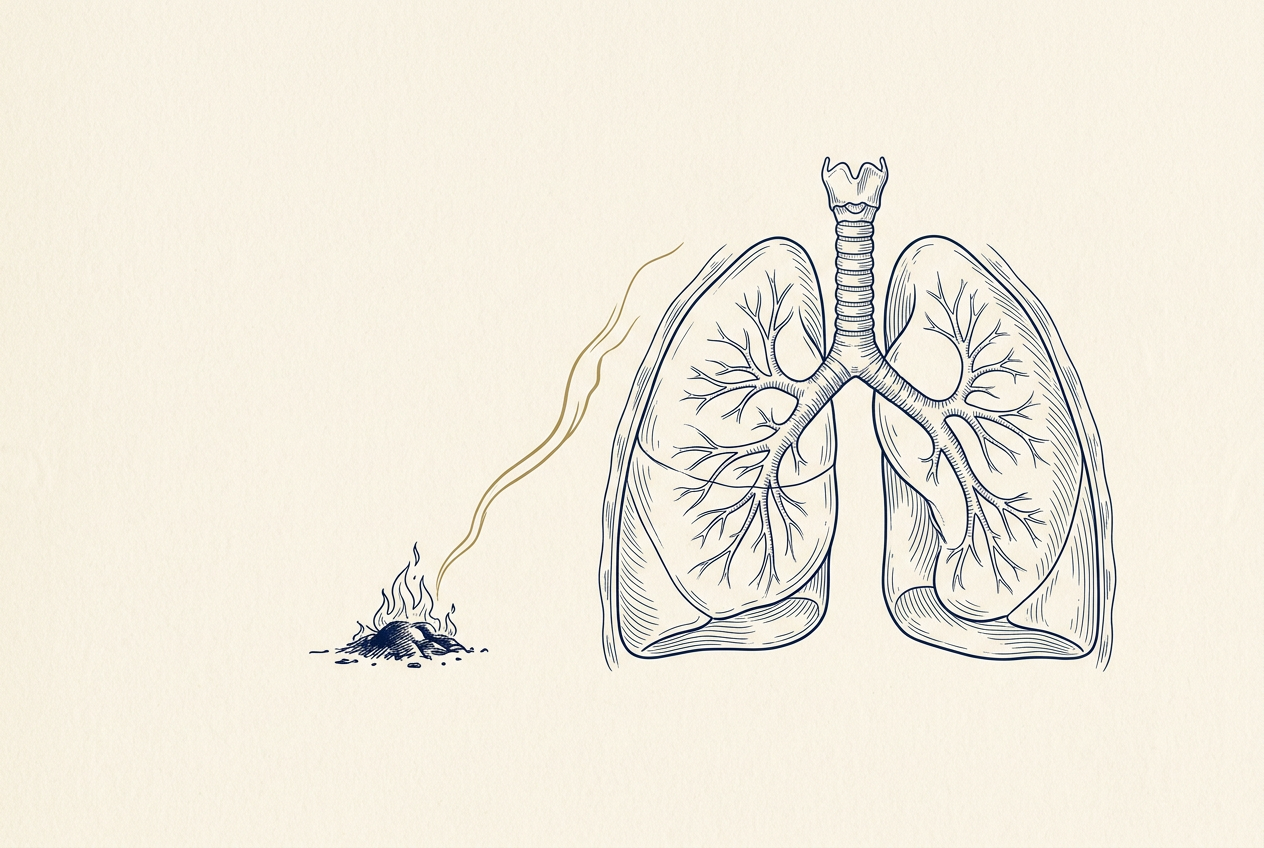
A normal breathing test does not end a burn pit claim. The signature burn pit disease, constrictive bronchiolitis, is notorious for hiding from standard spirometry while the veteran cannot climb a flight of stairs. And since the PACT Act, exposure no longer has to be proven at all: qualifying service windows carry a presumption that almost nothing rebuts.
What the PACT Act changed for burn pit lungs
For twenty years, veterans who breathed burn pit smoke had to prove the smoke caused their lung disease, claim by claim, and most lost. The PACT Act flipped the burden. Veterans with qualifying service are now presumed exposed to fine particulate matter, and a long list of respiratory conditions is presumed service connected: no nexus letter, no exposure documentation, no proof the pit was upwind. The rules live in 38 CFR 3.320 and in the statute at 38 U.S.C. 1120.
Who qualifies
Two service windows carry the presumption of exposure:
- The Southwest Asia theater of operations at any time on or after August 2, 1990: Iraq, Kuwait, Saudi Arabia, Bahrain, Qatar, the UAE, Oman, the surrounding waters, and the airspace above them.
- Afghanistan, Djibouti, Egypt, Jordan, Lebanon, Syria, Uzbekistan, or Yemen on or after September 11, 2001.
Exposure is presumed unless there is affirmative evidence the veteran was not exposed, which in practice almost never exists.
The presumptive respiratory list
The regulation at 3.320 names asthma, rhinitis, and sinusitis (including rhinosinusitis), presumptive when they manifest to any degree, at any time after separation. The PACT Act statute extends the list to include chronic bronchitis, chronic obstructive pulmonary disease, constrictive bronchiolitis (also called obliterative bronchiolitis), emphysema, granulomatous disease, interstitial lung disease, pleuritis, pulmonary fibrosis, sarcoidosis, and respiratory cancers of any type. There is no manifestation deadline and no 10 percent threshold: a diagnosis today from service in 1991 qualifies.
How each condition is actually rated
The presumption gets the condition service connected; the money still comes from 38 CFR 4.97. What drives each rating:
| Condition | Code | What drives the rating |
|---|---|---|
| Asthma | DC 6602 | The higher of two independent tracks: pulmonary function results (FEV-1 percent predicted or FEV-1/FVC ratio) or treatment level (intermittent bronchodilator is 10, daily inhalational therapy is 30, monthly physician care or 3 or more steroid courses a year is 60, daily high-dose steroids is 100). Whichever track yields the higher rating controls. |
| Chronic rhinitis | DC 6522 | Greater than 50 percent obstruction of both nasal passages, or complete obstruction of one side, is 10; with polyps is 30 |
| Chronic sinusitis | DC 6510 to 6514 | Counted episodes: 1 or 2 incapacitating episodes a year needing 4 to 6 weeks of antibiotics (or 3 to 6 non-incapacitating episodes) is 10; 3 or more incapacitating (or more than 6 non-incapacitating) is 30; repeated surgeries with chronic complications is 50 |
| COPD, emphysema, chronic bronchitis | DC 6604, 6603, 6600 | Pulmonary function testing: FEV-1, FEV-1/FVC, DLCO, and exercise capacity |
| Constrictive bronchiolitis | No code of its own | Rated by analogy, usually under an obstructive or interstitial formula based on PFTs |
The constrictive bronchiolitis trap
Constrictive bronchiolitis is the signature burn pit disease, scarring in the smallest airways, and it has one cruel feature: standard spirometry can look normal while the veteran cannot climb a flight of stairs. Definitive diagnosis may require tissue sampling, sometimes through surgical or video-assisted lung biopsy, along with high-resolution CT and other advanced workups. That is why so many post-deployment breathing problems went unnamed for years. No single test is required, and the workup should be documented thoroughly regardless of method.
Because constrictive bronchiolitis has no diagnostic code, VA rates it by analogy under 38 CFR 4.20, and the choice of analog quietly sets the ceiling on the claim. Push for full testing, DLCO and cardiopulmonary exercise testing included, and confirm that the analog code actually captures the documented impairment. If the schedular result understates the disability, the exceptional-case referral under 38 CFR 3.321(b) exists for exactly this situation.
Any degree, any time
Compare this with the older Gulf War undiagnosed illness rule in 38 CFR 3.317, which requires the illness to reach 10 percent by a deadline. The 3.320 and PACT presumptions have no deadline and no minimum severity. Even a 0 percent grant is a strategic win: service connection is locked, VA health care and toxic exposure screening follow, and any future worsening, including a later cancer, builds on an established foundation.
Respiratory cancers
A cancer of the respiratory tract of any type is presumptive with qualifying service. Active malignancy rates 100 percent under DC 6819, and the 100 percent continues for six months after the last surgery, radiation, or chemotherapy. Only then does VA examine the residuals, and any reduction must follow the procedures of 38 CFR 3.105(e).
Common details veterans overlook
- Denied before the PACT Act? File a supplemental claim. The new presumption is new evidence by definition, and grants can reach back.
- The asthma note matters: without clinical findings at the exam, a verified history of asthma attacks must be in the record. Get the diagnosis and attack history documented.
- Rhinitis at 30 percent requires polyps, documented by imaging or endoscopy. If polyps are in a private ENT record, submit it.
- "Incapacitating" sinusitis is defined: an episode requiring bed rest and treatment by a physician. Use those words in the record when they are true.
- A smoking history does not defeat a presumptive. Only affirmative evidence of another cause rebuts it.
One more thing worth knowing: VA is still working through a significant claims inventory. You can watch the current numbers on our live backlog tracker.